


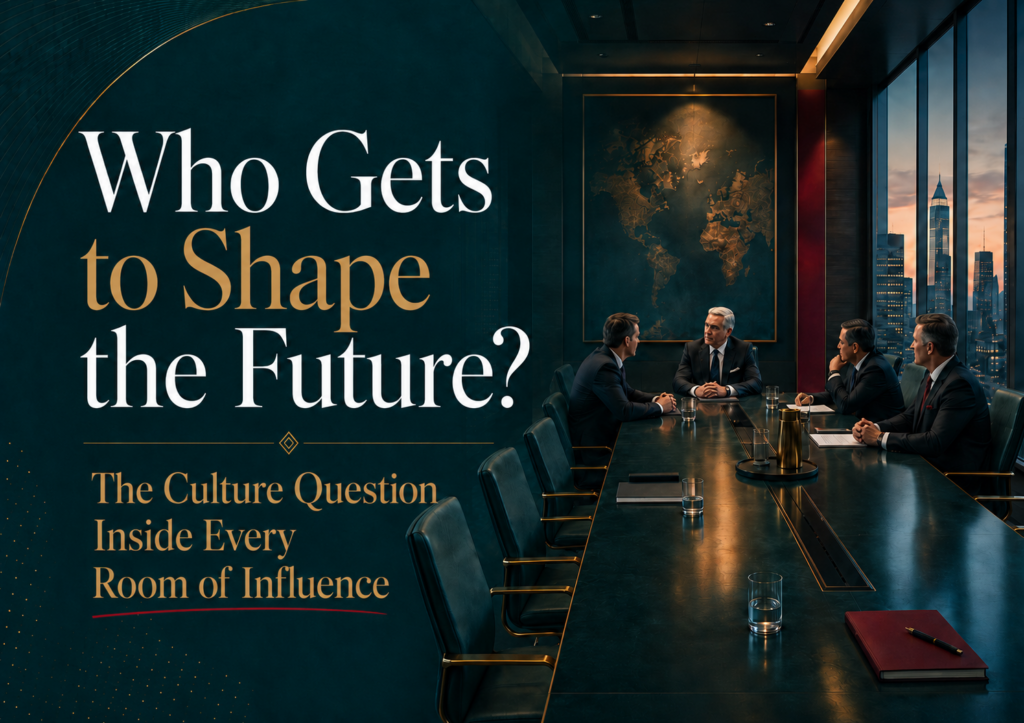
This June, I am thinking about rooms.
Physical rooms and spaces of influence.
The rooms and spaces where leaders gather. Where the future is imagined and strategy is shaped. Where decisions are made long before most people feel the impact of those decisions.
Some of these rooms and spaces are highly visible. Others are quieter, but no less powerful. The conversation before and after the formal meeting. The budget discussion where stated priorities are either supported or sacrificed. The closed-door exchange where someone decides what matters now, what can wait, and what never makes it onto the agenda at all.
Every organization has these rooms. The question is not whether these rooms and spaces exist. The question is who has access to them, who is absent from them, and what assumptions are allowed to sit in them unchallenged.
On June 3, I will attend the Forbes Iconoclast Summit. This year’s theme is Global Icons: A New Playbook for the Road Ahead.
The summit is convening influential dealmakers, financial leaders, investors, and market movers for conversations about a global economy at an inflection point: fragmented markets, restructured trade alliances, an AI arms race, strategic dealmaking, resilient portfolios, and the search for competitive advantage in a rapidly changing world.
In other words, it is a room where powerful people will be talking about the future. And I am entering that room with a question that sits at the center of my work in organizational culture:
Who gets to shape the future, and what kind of culture is created by the decisions made in rooms and spaces of influence?
Because the future of organizations is not shaped only by technology, innovation, capital, market trends, or economic forecasts. The future is shaped by the people in the rooms. By who has influence, which questions are welcomed, which are avoided, and by what leaders are willing to name, challenge, protect, fund, and change.
The room where leaders decide whether people are an asset to be invested in or a cost to be managed. Where leaders decide whether equity is a value or a vulnerability. Where leaders decided whether AI adoption will be guided by human impact or only by speed, efficiency, and market pressure. The room where leaders decide whether culture is central to strategy or something to revisit after the “real work” is done. The room where leaders decide whether the people closest to the problem will be invited into the conversation or simply informed of the decision after it has already been made.
Culture takes shape in the rooms where tradeoffs are made. Those rooms expose what leadership actually values, and what organization actually believes. They reveal whether the organization is building the future it claims to want or protecting the systems it has already learned how to manage.
Every room of influence creates a ripple. What gets normalized becomes behavior across the organization, what gets ignored becomes harm, what gets rewarded becomes culture. And what and who gets repeatedly left out of those rooms eventually becomes the limit of the organization’s imagination.
That is why one of the most important questions leaders can ask is:
Are the rooms shaping our future wide enough, honest enough, and courageous enough to create the future we say we want?
Because a new playbook for the road ahead cannot only be about markets, capital, AI, dealmaking, disruption, and competitive edge. The road ahead requires leaders to have a new level of cultural consciousness. To be able to ask:
Who benefits from the playbook? Who bears the burden of it? Who was in the room when it was written? Whose future was imagined? Whose experience was missing? And what kind of organization are we becoming as we pursue what comes next?
Too often, organizations talk about transformation while keeping the same rooms intact. The same voices. The same assumptions. The same patterns of decision-making. They want innovation without disruption. Inclusion without redistributed influence. Speed without reflection. They want culture change without changing the spaces where culture is actually made.
But culture does not shift because leaders announce new priorities. Culture shifts when leaders change what and who gets heard, what gets challenged, funded, measured, and who has meaningful influence over the decisions that shape the organization’s future.
Intentional leadership includes the discipline of noticing where power is operating, where drift is happening, and where alignment must be restored.
It is the willingness to pause before decisions become direction and ask: Who is in this room? Who is not? Whose expertise are we overvaluing? Whose lived experience are we undervaluing? What assumptions are we treating as truth? What possibilities are we unable to see because of who is missing? And perhaps most importantly, What culture are we creating by what we repeatedly normalize?
Because the room where the future is shaped determines the kind of future that becomes possible.
So as I enter this month, I am paying attention to rooms. The rooms I am invited into. The rooms I create. The rooms I observe. The rooms organizations protect. The rooms where possibility expands. And the rooms where the future is narrowed before it ever reaches the people who will have to live inside it.
This week, I invite you to do the same. Pay attention to the rooms where your organization’s future is being shaped. Who is in them? Who is missing? What questions are not being asked? Whose concerns are treated as strategic, and whose concerns are treated as inconvenient? What gets funded, delayed, defended, dismissed?
And in every room of influence, ask What culture is being created here?
Because the future of your organization is being imagined, shaped, and decided in rooms of influence. Intentional leaders have a responsibility to make sure those rooms are broad enough, deep enough, and honest enough to hold the full complexity of the future they are trying to create and courageous enough to challenge the assumptions that would otherwise shape the future unchecked.
That is the culture question inside every room of influence.