


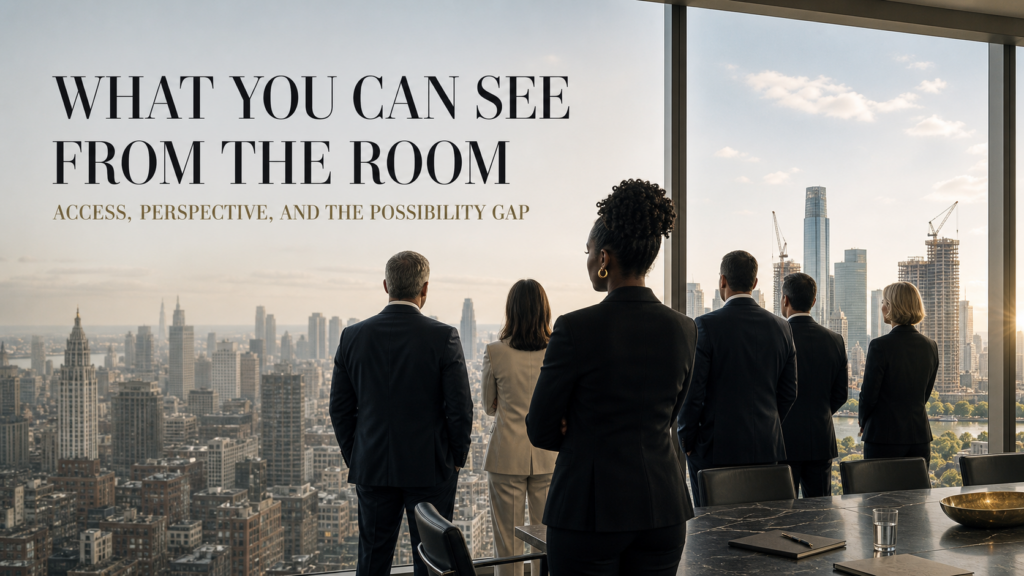
Earlier this month, I attended the Forbes Iconoclast Summit carrying a question:
Who gets to shape the future, and what kind of culture is created by the decisions made in rooms and spaces of influence?
It was the question at the heart of my June 1 newsletter. I wanted to pay attention not only to what was being discussed, but also to who was in the room, what possibilities they could see, and what their conversations revealed about leadership and culture.
I heard about deglobalization, domestic manufacturing, digitization, artificial intelligence, investment opportunities, women’s sports, and the future of wealth. I heard that volatility is the new normal and that existential challenges, while significant, are challenges humanity has faced and moved through before.
But the most important thing I noticed was not a prediction about markets, technology, or the economy.
It was the striking difference in perspective and how that perspective shaped the way people viewed the future.
Many people are experiencing this moment as one of uncertainty and contraction. Yet inside that room, filled with industry titans, investors, and people with extraordinary access to capital and influence, the prevailing outlook was not fear.
It was excitement.
And I realized that where I have sometimes seen the future narrowing, many in that room saw it widening.
That contrast left me with a new question:
How does our position in relation to power, capital, access, and opportunity shape the future we are able to see?
Where We Stand Shapes What We See
For most of my career, I have been employed by organizations. I have led from within, shaped strategy, advised executives, and influenced institutional decisions. But I have still experienced the economy primarily as an employee rather than as an owner of significant capital or a titan of industry.
That distinction matters.
My perspective has been shaped by the experiences of employees and communities facing disruption, displacement, and uncertainty. From that vantage point, the future can feel frightening.
Artificial intelligence threatens jobs. Economic volatility threatens security. Institutional instability threatens what people believed they could rely upon. Organizational change affects people who may have little control over the decisions reshaping their lives.
But many of the people in that room were not afraid of the future.
They were energized by it.
Where employees may see disruption, investors see emerging markets. Where organizational leaders may see workforce uncertainty, owners of capital may see opportunities to build, acquire, and invest. Where communities may see instability, people with access to capital, information, relationships, and influence may see openings.
Their proximity to opportunity allows them to experience uncertainty differently.
Neither perspective is wrong yet neither tells the entire story.
But the contrast revealed something intentional leaders cannot afford to ignore:
Our position in a room shapes what we can see from it. And our position in relation to power, capital, and opportunity shapes how we view the future.
The Possibility Gap
How can the same future appear so threatening from one vantage point and so full of promise from another?
The difference is not simply optimism or mindset.
People with resources, relationships, information, and access are often close enough to change to see where new opportunities are forming. They may also have greater protection from the consequences when risks do not pay off.
Others encounter that same change through job insecurity, rising costs, organizational restructuring, or decisions made in rooms they cannot enter. Before they can consider what might be gained, they must confront what they could lose.
This creates what I think of as a possibility gap: the distance between those who can see, access, and act upon emerging opportunities and those who experience the future primarily as something happening to them.
That gap has significant implications for leadership.
Leaders sometimes interpret employees’ fear as resistance, pessimism, or an unwillingness to adapt. But people cannot be expected to feel excited about a future in which they cannot yet see a place for themselves.
It is not enough to tell people that change is coming. Intentional leaders must help them understand what the change means, how they can participate in it, and what support, skills, information, and access they will need to move forward.
At the summit, Olivia Walton, founder and CEO of Ingeborg Investments, spoke about expanding economic opportunity for women and families. She captured the issue in one sentence:
“Talent and ambition are everywhere. Access and opportunity are not.”
Access does more than open doors. It shapes what people can imagine for themselves. It can determine whether the future feels like something being done to them or something they have the agency and opportunity to help shape.
The Leadership Responsibility
The intentional leadership lesson I carried out of Iconoclast is that leaders must become more conscious of how privilege, position, and proximity influence what we see.
If you occupy a room where opportunity appears abundant, do not assume everyone can see what you see.
Show them.
Do not mistake fear for resistance when people have not been shown how they fit into the future you are asking them to embrace.
Create pathways into the opportunities you are discussing. Share information before decisions are final. Bring more voices into the rooms where the future is imagined. Invest in people. Help them develop the knowledge, relationships, confidence, and access to participate in what comes next.
The question for intentional leaders becomes:
What are we doing to ensure more people can see themselves in the future we are shaping?
Because the future may be filled with possibility. But possibility without access remains privilege.
And the work of intentional leadership is not merely to recognize opportunity from inside the room.
It is to widen the room and expand the view.