

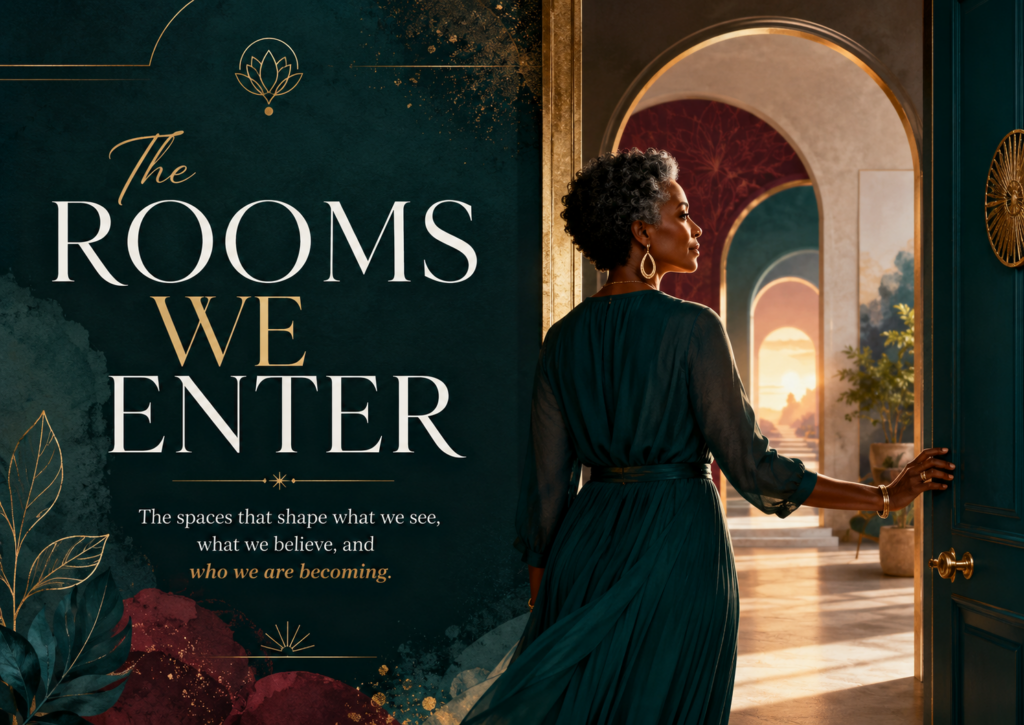
This month I am entering several rooms, and each one has me thinking about the spaces that shape us.
Rooms and spaces of power, visibility, womanhood, transition, and becoming.
I will enter a room where global leaders are shaping the future.
I will enter a room where women will gather to talk about beauty, visibility, identity, confidence, and how we see ourselves.
And I will enter a room I created for women navigating the space between who they have been and who they are becoming.
At first, these may sound like separate experiences, but for me, they are deeply connected by one powerful truth:
The rooms we enter do not simply hold us. They shape how we see ourselves, what we believe is possible, and how much of ourselves we allow to bring through the door.
Because for women, rooms are rarely neutral.
Some rooms expand us. They introduce us to ideas, people, and futures we may not otherwise have imagined. They help us see ourselves differently. They remind us that more is possible. They affirm parts of us that were waiting for permission to emerge.
But some rooms require us to shrink. They welcome our excellence, but not always our truth. They admire our strength, but leave little room for our softness. They admire our beauty, but resist our complexity. They celebrate our confidence, but only when it remains contained. They celebrate our leadership, but only when it does not disrupt the comfort of others.
Most of us learn early how to enter a room and quickly assess who we are expected to be there. We know how to read and adjust to the room. How to be impressive, but not intimidating. Beautiful, but not vain. Confident, but not arrogant. Strong, but not hard. Soft, but not weak. Visible, but not too visible.
We know when to speak, when to soften, when to hold back, when to smile, when to prove, when to adjust, and when to leave certain parts of ourselves outside the door.
We learn how to become the version of ourselves the room knows how to receive.
But at some point, the question stops being How do I succeed in this room? And becomes Can I still be fully myself here?
That question matters.
Because the room that once affirmed you may no longer have enough space for the woman you are becoming.
Your definition of success is no longer only about being chosen, invited, applauded, promoted, validated, or admired. It is also about being whole.
It is about being able to enter any room without abandoning yourself.
That is why the rooms I am entering this month feel connected.
The Forbes Iconoclast experience is a room of power and influence, a place where leaders are shaping the future. And even there, the question of rooms matters. Who is in the room? Whose voices are shaping the future? Whose lived experience is being valued? Whose imagination is being centered? What possibilities become visible because of who is present? And what possibilities remain unseen because of who is missing?
The Lune Noir conversation is a room of visibility and womanhood. A space to explore beauty, identity, confidence, and how women see ourselves in a world that is constantly reflecting images, standards, expectations, and assumptions back to us. Because beauty is never only about appearance. Visibility is never only about being noticed. For us, visibility is tied to identity, safety, confidence, power, perception, and permission. Who do we believe we are allowed to be? How much of ourselves do we reveal? Where do we feel seen? Where do we feel scrutinized? Where do we feel celebrated? Where do we feel reduced?
And then there is The Room Between.
The room I created. A room for women navigating the space between who they have been and who they are becoming. Because there are seasons in a woman’s life when she is not simply changing jobs, ending relationships, starting businesses, raising children, becoming an empty nester, caring for aging parents, redefining success, or reimagining her future.
She is becoming someone new. And that kind of transition requires a different kind of room.
Not a room where she has to pretend the transition is tidy. Not a room where she has to make her becoming easy for everyone else to understand. But a room where she can pause. Reflect. Tell the truth. Be witnessed. Ask new questions. Release old definitions. Reclaim hidden parts of herself. And begin to imagine what comes next from a place of consciousness, not pressure.
Because the space between who we have been and who we are becoming is not empty. It is where becoming happens.
And sometimes the most transformational room is not the one we finally get invited into. Sometimes it is the one we decide to create. A room where we do not have to shrink to belong. A room where beauty can include depth, age, softness, strength, contradiction, history, and power. A room where transition is not treated as instability, but as sacred evidence that something new is emerging. A room where becoming is not rushed, minimized, or explained away.
That is the invitation I am holding this month.
Not simply to enter more rooms. But to become more conscious of the rooms we enter. To notice how they shape us. To question what they require of us. To name the rooms we have outgrown. And to create the rooms we could not find when we needed them most.
Because the rooms we enter shape what we see.
The rooms we remain in shape what we normalize.
The rooms we outgrow reveal who we are becoming.
And the rooms we create may become the place where other women finally exhale, tell the truth, and begin again.
This Week’s Reflection
This week, ask yourself:
How do the rooms and spaces I enter shape what I see, what I question, what I imagine, and what I believe is possible?
What have I had to leave outside the door in order to be accepted inside the room?
What room once affirmed me but now confines me?
And what kind of room do I need now?
🌸 SHIFT Into Your Highest Self™
If you feel called to explore what your next chapter might look like, the SHIFT Into Your Highest Self Coaching Experience is designed to help women move from shrinking toward unapologetically thriving.