


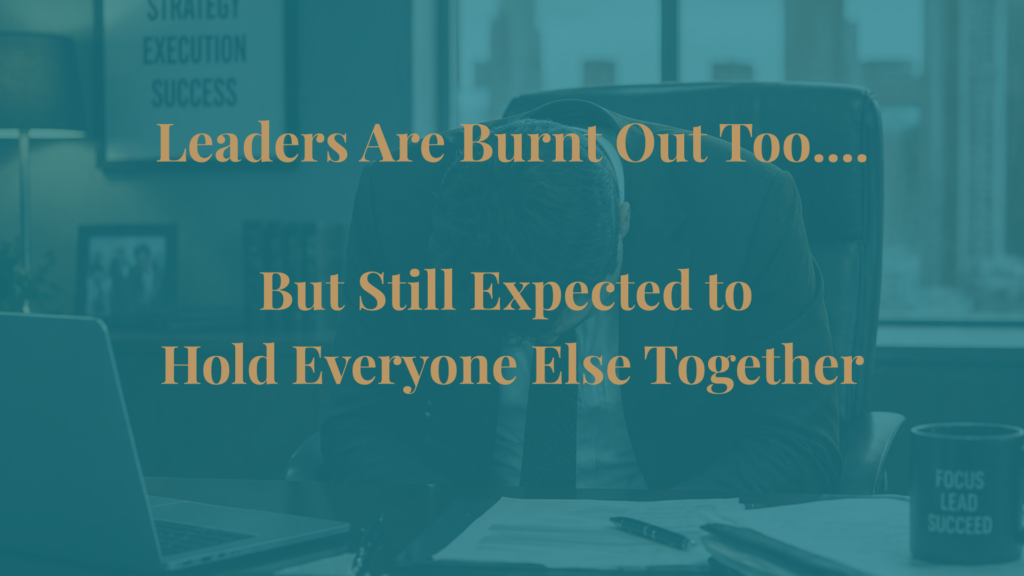
Part 1 of the 2 Part Series on Mental Health at Work: A Leadership Reality Check
Can we stop pretending leaders are somehow separate from the employee experience? They’re not.
Leaders are employees operating inside the same systems, pressures, and expectations. And yet, the way we talk about burnout, stress, and mental health suggests they’re somehow exempt. They’re not.
In May, when conversations about mental health are at their loudest, we rarely talk about the mental health of leaders. We talk about supporting employees. We talk about resources. We talk about well-being initiatives. But we almost never ask “What is it costing the people expected to hold everything together?”
Because burnout isn’t just happening below management. Mental health isn’t just a non-management issue. It’s happening at every level, including the very people expected to fix it.
A significant number of leaders charged with addressing burnout, disengagement, and attrition are exhausted themselves. They are questioning their sustainability. And in many cases are quietly wondering how much longer they can do this.
They just don’t say it out loud.
But I Can See It
I’m in rooms with executive teams where the conversation sounds like this:
“We need to address morale.”
“People seem disengaged.”
“Performance is slipping.”
But I also pay attention to what doesn’t get said. The pause before someone speaks. The subtle shift in energy when the conversation gets too close to something real. The unspoken agreement to keep the conversation focused outward, because the moment it turns inward to their own capacity, strain, and sustainability, the room goes quiet.
The truth is, the leaders themselves:
- Are running on empty but still expected to perform certainty.
- Are making high-stakes decisions without time to think.
- Know everyone is tired but no one is stopping.
The Data Confirms What Leaders Won’t Say
According to Deloitte, nearly 70% of C-suite leaders have seriously considered leaving their roles for one that better supports their well-being.
So if you’re feeling it, you’re not the exception. You’re in the majority.
The Pressure Leaders Are Carrying
Leaders today are expected to:
- Deliver results in ongoing uncertainty
- Absorb pressure from above and below
- Make decisions without full information
- Maintain stability while everything around them is in a constant state of motion
And increasingly to do all of that while their own capacity is compromised.
Research highlighted by Harvard Business Review points to decision fatigue, isolation, and constant pressure to project confidence as defining features of leadership strain today.
What that research doesn’t fully capture is that leaders don’t have space to be impacted by the environments they are expected to stabilize.
Leadership right now is not just demanding, it’s downright relentless. The pace hasn’t slowed. The expectations haven’t adjusted. The complexity hasn’t decreased. But capacity has. And instead of recalibrating, most leaders are overcompensating. Working longer, thinking faster, carrying more, and pushing beyond sustainable limits while calling it leadership responsibility.
The part that rarely gets named is that many leaders feel stuck between what the role requires and what they can actually sustain, and are unsure how to step back without consequence.
So What Can Leaders Actually Do?
Not in theory. Not when things slow down. Now.
1. Tell yourself the truth about your capacity: Not what the role demands, and not what you think you should be able to carry. What you can actually sustain right now.
2. Stop normalizing depletion as leadership: Being constantly exhausted is not a leadership requirement, it’s a signal. And ignoring it doesn’t make you stronger, it makes you less effective.
3. Build non-negotiable thinking space: If every moment is reactive, your leadership will be too. Even 30 minutes of uninterrupted thinking time is not a luxury. It’s a leadership necessity.
4. Make one visible boundary and hold it: Not ten, just one. Leave on time one day. Don’t respond after a certain hour. Block real space on your calendar.
5. Recognize that pressure distorts perspective: If everything feels urgent, it’s likely not. When you’re depleted, urgency expands. Clarity requires space.
6. Stop carrying what isn’t yours to carry alone: Leadership can be isolating but it shouldn’t be silent. Whether it’s a peer, a coach, or a trusted advisor, you need a space where you don’t have to perform.
The Reframe
This isn’t about stepping away from leadership. It’s about leading in a way that is actually sustainable. Because leadership that requires self-neglect is not strong leadership, its unsustainable leadership.
The Leadership Question
What is one boundary, reset, or conversation you need to initiate this week to make your leadership sustainable?
Not someday. Not when things slow down. Now.
Because if Mental Health Month is going to mean anything it has to include the mental health of leaders, too.
An Invitation to SHIFT
This is the work leaders rarely make space for but need most. If you are a senior leader to navigating this space, I offer a limited number of executive coaching engagements each year. I invite you to schedule a complimentary, no-obligation conversation to see whether that support might be helpful.