


Part 2 of a 2 Part Series on Mental Health at Work: A Leadership Reality Check
We can’t talk about mental health at work without talking about leadership. Both how leaders are doing and how they lead.
So, let’s be honest: most organizations aren’t actually supporting mental health. They’re performing it.
And every May, that performance gets louder. Panels. Resources. Campaigns. Statements.
A temporary change in language without a shift in behavior. And then June comes and nothing fundamental has changed.
The Data Is Already Telling on Us
According to American Psychological Association:
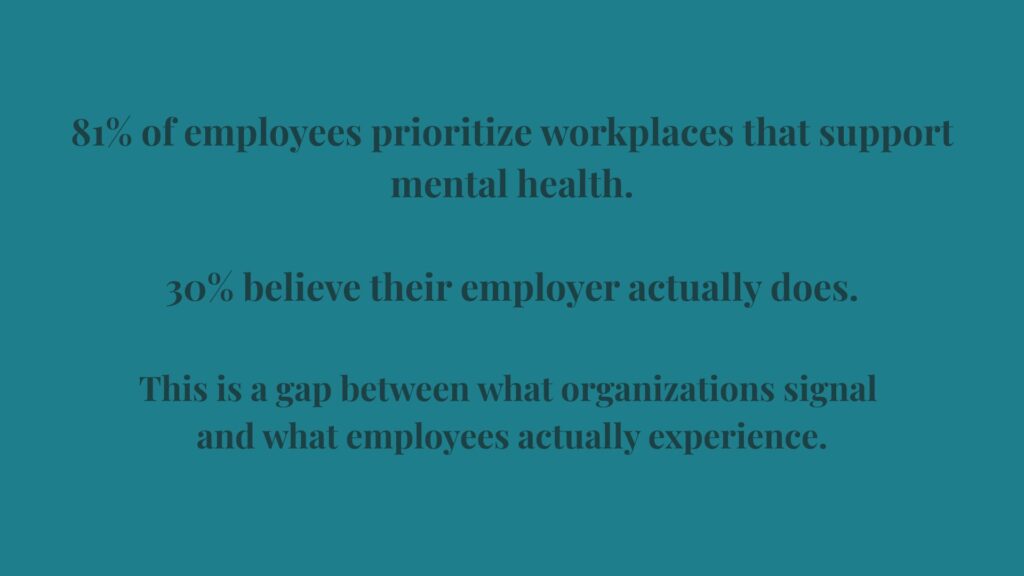
- 81% of employees say they will prioritize workplaces that support mental health
- Only about 30% believe their employer actually does
Research from McKinsey & Company found that toxic workplace behavior is the single largest predictor of burnout, even more than workload. So the issue isn’t just how much work there is. It’s how people are being led while doing it.
Organizational Signaling vs. Employee Experience
Leaders often believe they are supportive because they:
- Encourage people to take time off
- Offer resources
- Acknowledge stress in meetings
And on the surface it sounds like support. But what employees actually experience is:
- Expectations that never change—even when capacity clearly has
- Timelines that were unrealistic before… and are still unrealistic now
- Middle-of-the-night emails that signal “this is what commitment looks like”
- The subtle side eye when someone actually does take time off
- Leaders who tell others to rest—but never step away themselves
- Calendars packed with back-to-back meetings with no space to think or breathe
- After-hours events framed as “optional”… that don’t really feel optional
- “Flexibility” that only works in one direction—toward the organization’s needs
- Praise for resilience… instead of questioning why so much resilience is required
And perhaps most importantly, what happens after someone sets a boundary, because that moment tells the truth.
People don’t experience your wellness messaging. They experience your expectations.
The Drift
Mental health becomes performative when:
- It’s seasonal
- It’s delegated
- It’s discussed—but not examined
When leaders are encouraged to support mental health without being asked to examine how their own leadership may be undermining it.
Employees notice. And over time, they stop engaging, not because they don’t need support, but because they don’t trust the environment.
What Actually Supports Mental Health
Leaders who genuinely support mental health—consistently, not seasonally—do things differently:
1. They reset expectations, not just acknowledge stress: When capacity changes, the work changes, not just the conversation about it.
2. They model boundaries in ways that are real and visible, not symbolic: Not performative “I’m offline” messages, but actual disconnection that doesn’t get quietly penalized.
3. They stop rewarding overextension: If the people doing the most are also the most depleted that’s not high performance, that’s misalignment.
4. They make it safe to tell the truth: Not “open door” in theory but environments where speaking candidly doesn’t carry risk.
5. They examine their own behavior under pressure: Pressure reveals leadership more than any value statement ever will.
6. They align pace with sustainability: Urgency becomes the exception, not the default operating model.
The Hard Truth
You can offer every mental health resource available, but if your leadership sustains unrealistic expectations, signals that rest is risky, and rewards availability over well-being, those resources won’t just go unused; they’ll be seen as disingenuous.
The Leadership Reframe
Mental health at work is not an initiative. It is the cumulative effect of leadership behavior. Every day. In every interaction.
The Leadership Question
Does your leadership make it possible for people to be well or just necessary for them to perform anyway?
Where does your leadership contradict your message about mental health?
Because that’s where your culture is actually being defined.
Intentional leadership is the discipline of alignment between what you say matters and how you actually lead. If mental health only shows up in May, it’s not intentional leadership. It’s a performance. And your employees can tell the difference.
An Invitation to SHIFT
I work with leaders and executive teams to move from performative care to aligned leadership practice—so mental health is not a moment, but a lived experience.
If you are a senior leader to navigating this space, I offer a limited number of executive coaching engagements each year. I invite you to schedule a complimentary, no-obligation conversation to see whether that support might be helpful.