


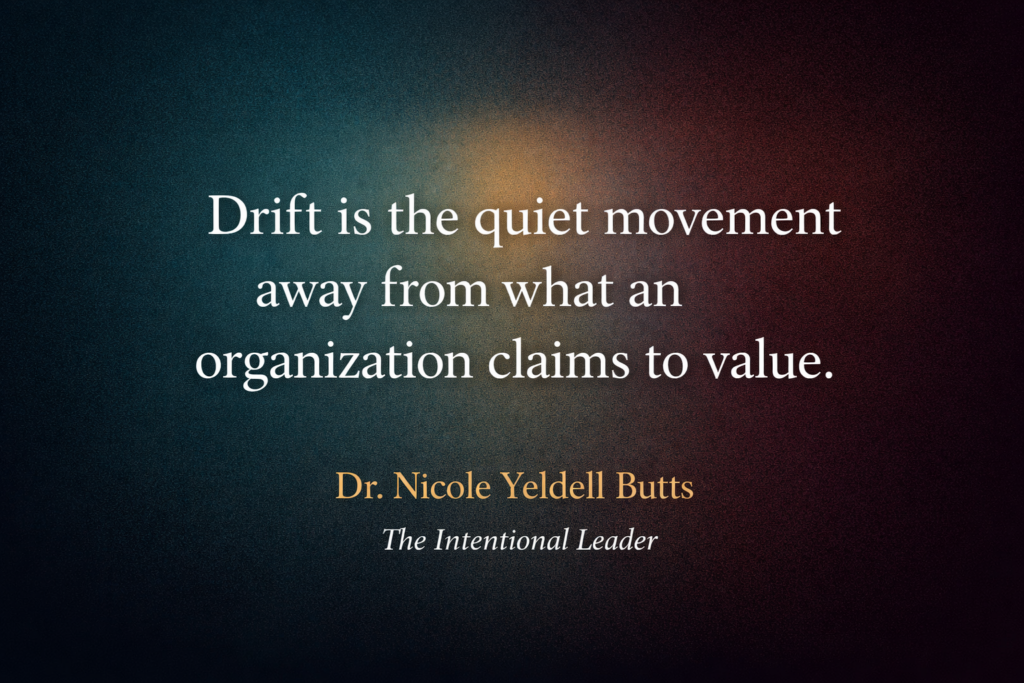
When leaders notice misalignment, the instinct is often to revisit strategy.
But drift rarely occurs because strategy is unclear.
More often, drift emerges through the daily mechanics of leadership.
Meeting agendas fill with operational updates.
Short-term metrics dominate discussion.
Strategic reflection slowly disappears.
No one decides this should happen.
But gradually, operational urgency begins to crowd out strategic attention.
Over time, that drift begins reshaping the organization’s direction.
Preventing drift, therefore, is less about rewriting strategy and more about how leaders structure their attention and conversations.
When leaders recognize this pattern, they have an opportunity to SHIFT — a deliberate choice to realign leadership attention with what the organization says matters most.
Four Leadership Practices That Create a SHIFT
Leaders who sustain alignment tend to rely on a few consistent practices.
Not dramatic interventions.
But small, repeatable leadership behaviors that help counteract drift.
1. Protect Strategic Conversation Time
Operational demands will always expand to fill available time.
Intentional leaders protect space for strategic reflection.
This might mean dedicating part of every leadership meeting to questions such as:
• What are we learning right now?
• What patterns are emerging?
• What requires our strategic attention?
Without protected space for reflection, operational urgency gradually pulls leadership attention away from strategy.
Creating space for these conversations is often the first SHIFT leaders make.
2. Revisit Organizational Priorities Regularly
Most organizations articulate their priorities clearly at the beginning of the year.
But over time, those priorities can quietly fade from daily leadership dialogue.
Intentional leaders keep them visible.
They reference them in meetings.
They connect decisions to them.
They ask whether current work reflects them.
These simple practices help leaders make a SHIFT from reactive activity back to intentional direction.
3. Align Metrics with Meaning
Organizations measure what they value.
But measurement systems can gradually narrow attention toward what is easiest to track rather than what matters most.
Intentional leaders periodically pause and ask:
Are we measuring only what is easy to count — or what truly reflects our priorities?
Expanding what leaders measure often creates an important SHIFT in organizational focus, reconnecting performance metrics with purpose.
4. Model Reflective Leadership
Perhaps the most powerful SHIFT leaders can make is behavioral.
Intentional leaders model reflection.
They pause before reacting.
They ask thoughtful questions rather than rushing to solutions.
They create space for curiosity, learning, and thoughtful dialogue.
When leaders model this behavior, they signal that thoughtful leadership matters just as much as efficient execution.
Alignment Is an Ongoing Discipline
Drift is not something leaders eliminate once.
It is something leaders must continually notice and manage.
Every organization will feel the pull of operational urgency.
Every leadership team will occasionally find its attention drifting.
Leadership lies in recognizing those moments — and choosing to make a SHIFT back toward alignment.
Small, intentional adjustments often restore clarity more quickly than leaders expect.
Reflection for Leaders
Consider your own leadership rhythm.
Where might drift be quietly emerging in your organization?
And what small SHIFT in leadership attention or conversation might bring your team back into alignment?
Closing
Intentional leadership is not defined by perfect consistency.
It is defined by awareness.
Because drift happens quietly in every organization.
But when leaders notice it — and choose to SHIFT — they regain the power to realign their culture with what matters most.
An Invitation to SHIFT
If you or your leadership team are navigating questions of alignment, purpose, or culture, I offer a limited number of executive coaching engagements each year.
I invite you to schedule a complimentary, no-obligation conversation to see whether that support might be helpful.